
|
Sometimes, the "design process" for an item is not very complicated.
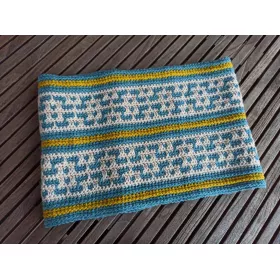
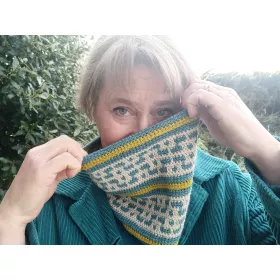
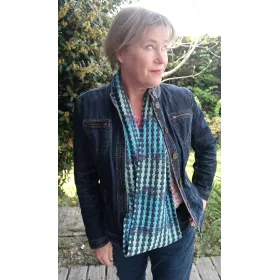
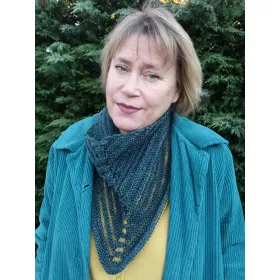
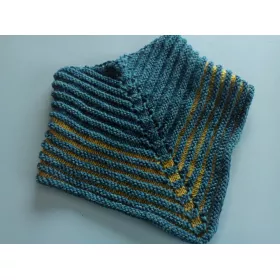
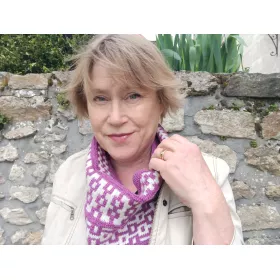
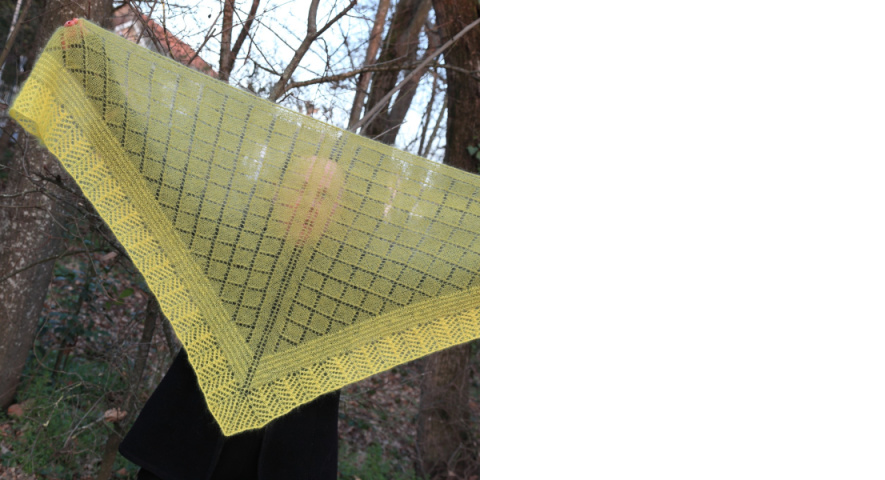
I needed a scarf to go with a simple jacket I had recently knitted. I also wanted to try out a beautiful stitch pattern I had spotted in a Japanese stitch dictionary.
Put these two together - and you have this design.
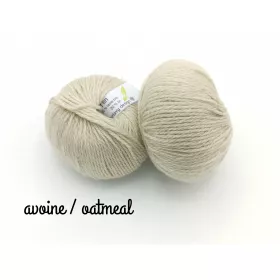
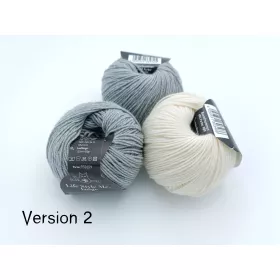
Yarn: 2 balls of BB Merinos by Fonty, 100% merino wool, 200m/220 yds per 50 g/1.75 oz ball.
Hook: 4 mm (US G-6).
Finished size: 160 x 23 cms (63 x 9"). (After blocking)
Gauge is absolutely not crucial for an item like this. If you use a thicker yarn, and a larger hook, you can still follow the instructions below, but you will obtain a wider scarf (and you might want to make it a little longer, too).
As always, it is important to adapt the hook size to the yarn used. As a guideline, the recommendation for the yarn I used was size 2,5 - 3 mm (US 2 - 3) knitting needles, and I used a 4 mm (US G-6) hook.
The scarf starts in the center and is worked toward the ends, one side at a time. This makes for a symmetrical scarf as regards the stitch pattern, and avoids any distortion due to the placement of the foundation chain.
Pattern:
Ch 49.
Row 1: Ch 3 (count as 1 dc). 4 dc in 4th ch from hook. *Ch 2. Skip 5 ch. Dc in next ch. Ch 2. Skip 5 ch. 4 dc in next ch, ch 2, 4 dc in same ch.* Repeat from * to * 2 times. Ch 2. Skip 5 ch. Dc in next ch. Ch 2. Skip 5 ch. 5 dc in last ch. Turn.
Row 2: Ch 3 (count as 1 dc). 3 dc in 1st stitch. *Ch 2. Skip 4 dc and 2 ch. Dc in dc from previous row. Ch 2. Dc in same dc. Ch 2. Skip 2ch and 4 dc. 3 dc in chain-space. Ch 2. 3 dc in same chain-space.* Repeat from * to * 2 times. Ch 2. Dc in dc from previous row. Ch 2. Dc in same dc. Ch 2. 4 dc in top of turning chain. Turn.
Row 3: Ch 3 (count as 1 dc). 2 dc in 1st stitch. *Ch 2. Skip 3 dc, 2 ch and 1 dc. 2 dc in chain-space. Ch 2. 2 dc in same chain-space. Ch 2. Skip 1 dc, 2 ch and 3 dc. 2 dc in chain-space. Ch 2. 2 dc in same chain-space.* Repeat from * to * 2 times. Ch 2. Skip 3 dc, 2 ch and 1 dc. 2 dc in chain-space. Ch 2. 2 dc in same chain-space. Ch 2. 3 dc in top of turning chain. Turn.
Row 4: Ch 3 (count as 1 dc). 1 dc in 1st stitch. *Ch 2. Skip 2 dc, 2 ch and 2 dc. 3 dc in chain-space. Ch 2. 3 dc in same chain-space. Ch 2. Skip 2 dc, 2 ch and 2 dc. 1 dc in chain-space. Ch 2. 1 dc in same chain-space.* Repeat from * to * 2 times. Ch 2. Skip 2 dc, 2 ch and 2 dc. 3 dc in chain-space. Ch 2. 3 dc in same chain-space. Ch 2. 2 dc in top of turning chain. Turn.
Row 5: Ch 5 (count as 1 dc + 2 ch). Skip 2 dc, 2 ch and 3 dc. *4 dc in chain-space. Ch 2. 4 dc in same chain-space. Ch 2. Skip 3 dc, 2 ch and 1 dc. 1 dc in chain-space. Ch 2. Skip 1 dc, 2ch and 3 dc. * Repeat from * to * 2 times. 4 dc in chain-space. Ch 2. 4 dc in same chain-space. Ch 2. 1 dc in top of turning chain. Turn.
Row 6: As row 4.
Row 7: As row 3.
Row 8: As row 2.
Row 9: Ch 3 (count as 1 dc). 4 dc in 1st stitch. *Ch 2. Skip 3dc, 2 ch and 1 dc. Dc in chain-space. Ch 2. Skip 1dc, 2 ch and 3 dc. 4 dc in chain-space, ch 2, 4 dc in same chain-space.* Repeat from * to * 2 times. Ch 2. Skip 3 dc, 2 ch and 1 dc. Dc in chain-space. Ch 2. 5 dc in top of turning chain. Turn.
Repeat rows 2-9.
Work until the scarf is half the desired length. Don't forget it will lengthen when blocked. I worked 6 full repeats and ended with row 3 in repeat number 7. Always end with a row 3 or 7.
Don't fasten off - continue with the border.
Border:
Every group of [2 dc in chain-space, 2 ch, 2 dc in same chain-space] on the last row of the scarf forms a "tip".
Row 1: Ch 1. 1 sc in 1st stitch. *Ch 7. 1 sc in chain-space of next "tip".* Repeat from * to * 6 times. Ch 7. 1 sc in top of turning chain. Turn.
Row 2: Ch 1. 1 sc in 1st stitch. *5 sc in chain arch. Ch 1. 5 sc in same chain arch. Skip sc from previous row.* Repeat from * to * 6 times. 5 sc in chain arch. Ch 1. 5 sc in same chain arch. 1 sc in last stitch. Fasten off.
Turn the scarf around. Work the other half of the scarf in the other direction. Start by working the first row in the remaining loop of the foundation chain.
Weave in all ends.
Blocking:
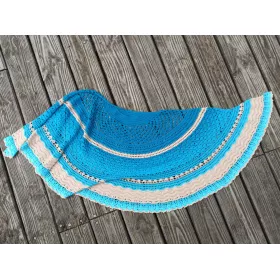
Block carefully, using the method of your choice. I soaked the scarf in tepid water, and rolled it in a towel to dry it as much as possible. I then pinned it to my blocking board, covered by another towel, using straight, thin knitting needles as blocking wires for the straight sides.
When pinning, make sure that you pin out the tips of the border carefully, placing a pin in the small chain-space.
Let dry and wear with pride!
Symbol chart:
(I'm sorry to be able to provide only a hand-drawn chart this time.)

Back to newsletter
Starting page of site (in english)
Contact
|